achilles tendinopathy
Achilles tendon pain or stiffness? Learn what mid-portion Achilles tendinopathy is, why it happens, and how Functional Soles Podiatry helps rebuild tendon strength.
Mid-portion Achilles tendinopathy is pain and irritation in the middle section of the Achilles tendon.
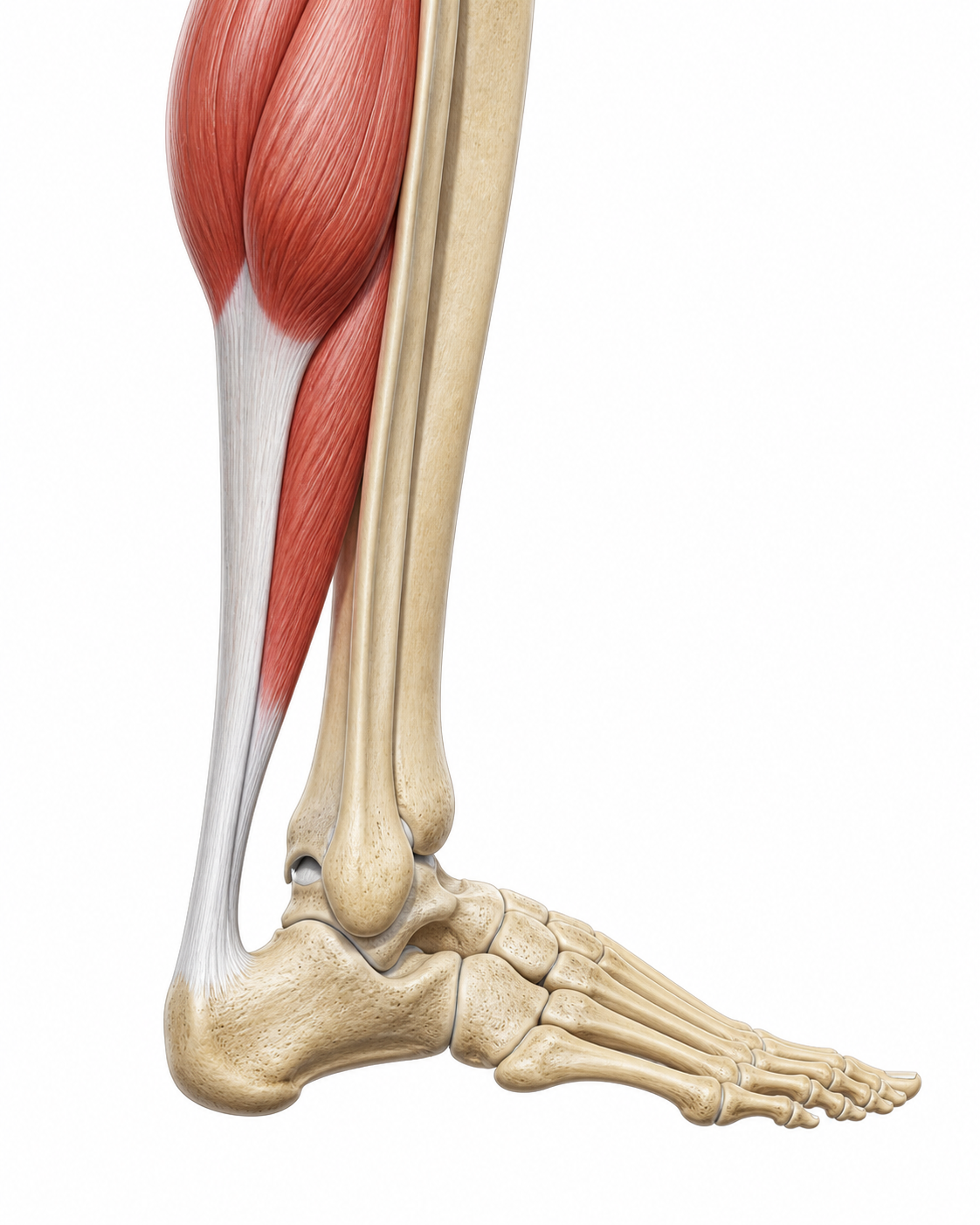
Your Achilles tendon connects your calf muscles to your heel. It helps you walk, run, jump, climb stairs, push off the ground, and absorb load.
During running, the Achilles tendon acts like a spring. It stores and releases energy with every step. When the load going through the tendon exceeds what the tendon can tolerate, it can become painful. This is known as Achilles tendinopathy.
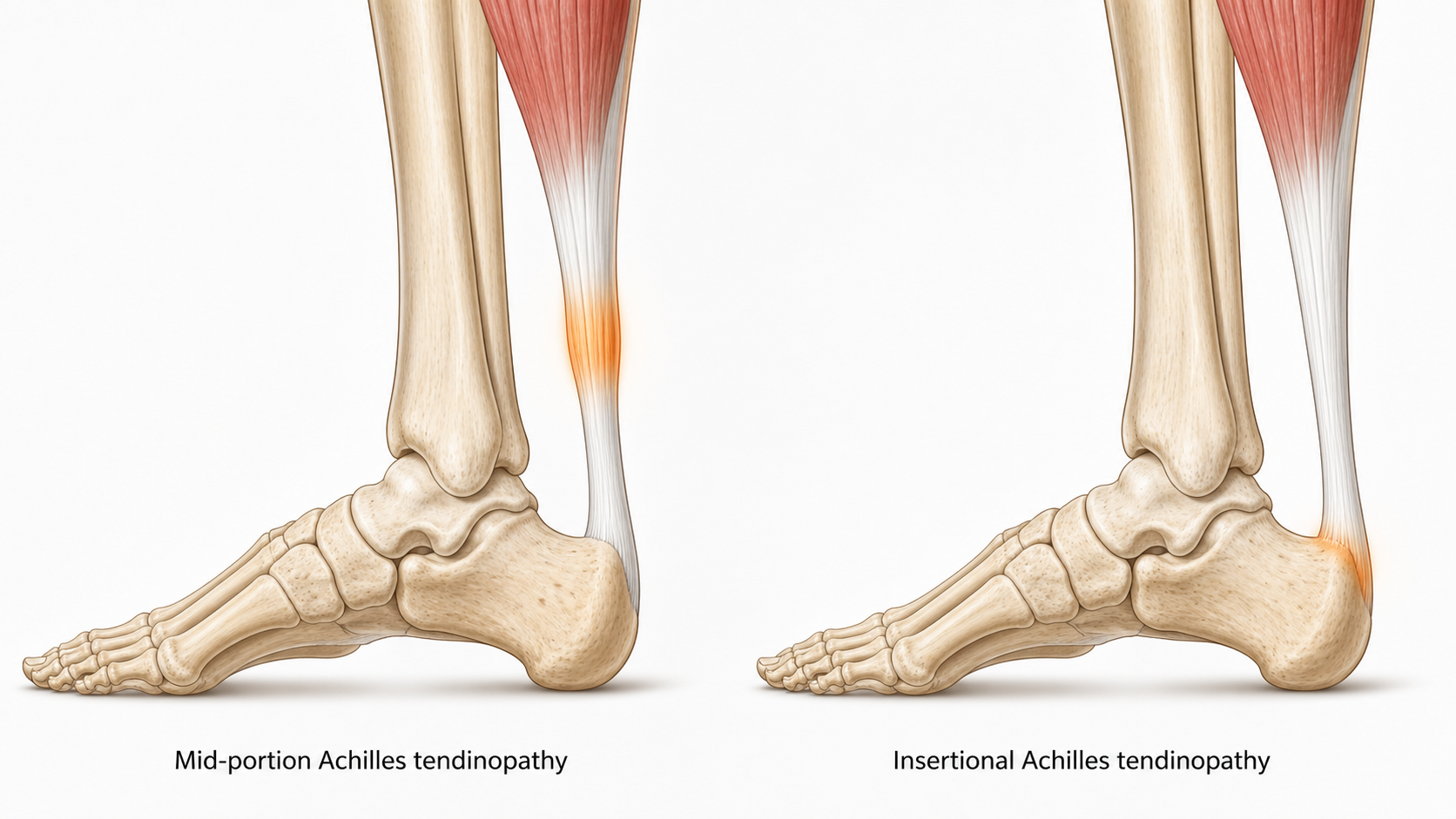
The most common area is the mid-portion of the tendon, usually around 2–6 cm above the heel.
What does Achilles tendinopathy feel like?
Mid-portion Achilles tendinopathy usually builds gradually rather than starting from a single event.
You might notice:
- stiffness in the Achilles tendon first thing in the morning
- pain when walking, running, jumping, or climbing stairs
- tenderness over the tendon
- stiffness after activity or the next day
- reduced calf strength or push-off power
- pain that warms up during activity, then returns later
Some people can keep running for a while because the tendon feels better once it warms up. The problem is that symptoms often return afterwards or the next morning, which tells us the tendon may not be coping with the total load yet.
Why does Achilles tendinopathy happen?
Achilles tendinopathy usually happens when there is a mismatch between tendon capacity and the load being placed on it.
Common triggers include:
- increasing running distance too quickly
- adding hills or speed work
- returning to sport after time off
- increasing gym, walking, or work activity
- changes in footwear
- reduced calf strength or endurance
- not enough recovery between loading sessions
Should I rest Achilles tendinopathy completely?
Usually, Achilles tendinopathy does not require full rest. Although rest may settle symptoms in the short term, it does not rebuild the tendons ability to handle load. Usually, an adjustment of load is the better solution.
That may mean temporarily reducing the things that are irritating the tendon, while keeping you moving in a way the tendon can tolerate.
The aim is not to shut everything down. The aim is to keep the tendon active while finding a level of load it can recover from.
How do you treat Achilles tendinopathy?
The most important treatment for mid-portion Achilles tendinopathy is progressive tendon loading. That means gradually rebuilding the strength, tolerance, and spring-like function of the calf and Achilles tendon.
Rehab often moves through four broad stages.
Stage 1: Settle pain and keep the tendon active
Early rehab is about calming symptoms while maintaining tendon activity. This may include isometric calf holds or other calf exercises that allow the tendon to work without being pushed too hard. The goal is to reduce irritability and find a starting point the tendon can tolerate.
Stage 2: Restore calf strength
Once symptoms are more settled, the focus shifts toward rebuilding calf and Achilles strength. This often includes controlled heel raise exercises with gradually increasing resistance. For runners and active people, strength matters because the Achilles tendon has to repeatedly absorb and produce force.
Stage 3: Rebuild spring and energy storage
Running and sport do not only require strength. They also require the tendon to work quickly. As symptoms improve, rehab may progress toward faster, more dynamic exercises such as hopping, skipping, jumping, or running drills. This stage helps prepare the tendon for the spring-like demands of running and sport.
Stage 4: Return to running and sport
Running and sport are then reintroduced gradually. This may involve adjusting distance, speed, hills, surfaces, and recovery days while monitoring how the tendon responds over the next 24–48 hours. The goal is not just to get you back once. The goal is to build enough capacity so the tendon can tolerate normal training again.
Can I keep running with Achilles tendinopathy?
It depends on how irritable the tendon is, how symptoms behave during and after running, and whether your running load can be modified enough to stay within a tolerable range.
Running may need to be reduced, changed, or temporarily paused if:
- pain increases as the run continues
- your running style changes because of pain
- symptoms are worse later that day or the next morning
- the tendon becomes more painful week to week
- you are relying on medication to get through activity
Does shockwave therapy help Achilles tendinopathy?
Shockwave therapy may be helpful in some persistent Achilles tendinopathy cases, especially when symptoms have been present for a long period of time. It is usually best viewed as an adjunct to rehab, not a replacement for it.
Shockwave therapy assists by ‘restarting’ the healing process in the body, by creating new red blood cells in the area, and reducing pain signals.
What is the difference between mid-portion and insertional Achilles tendinopathy?
Not all Achilles pain is the same.
Mid-portion Achilles tendinopathy affects the middle of the tendon, usually 2–6 cm above the heel. Insertional Achilles tendinopathy affects the area where the Achilles tendon attaches into the heel bone.
This matters because these are caused by different forces on the tendon, and require different treatments.
Achilles tendinopathy treatment at Functional Soles Podiatry
At Functional Soles Podiatry, we help people with Achilles pain find the right balance between reducing irritation and rebuilding capacity.
Our approach focuses on:
- understanding why the tendon became overloaded
- calming symptoms while keeping you moving where possible
- rebuilding calf and Achilles strength
- guiding your return to walking, running, gym, work, or sport
- using footwear, heel lifts, taping, or orthoses when they help create a better loading window
The aim is to help you get back to doing what matters with more confidence and a clearer plan.
What we offer
Our goal is to provide a long-term solution for you and your family.
We believe that every case is different and as such we will always work with you to find the best treatment for you and your needs.