Shin Splints
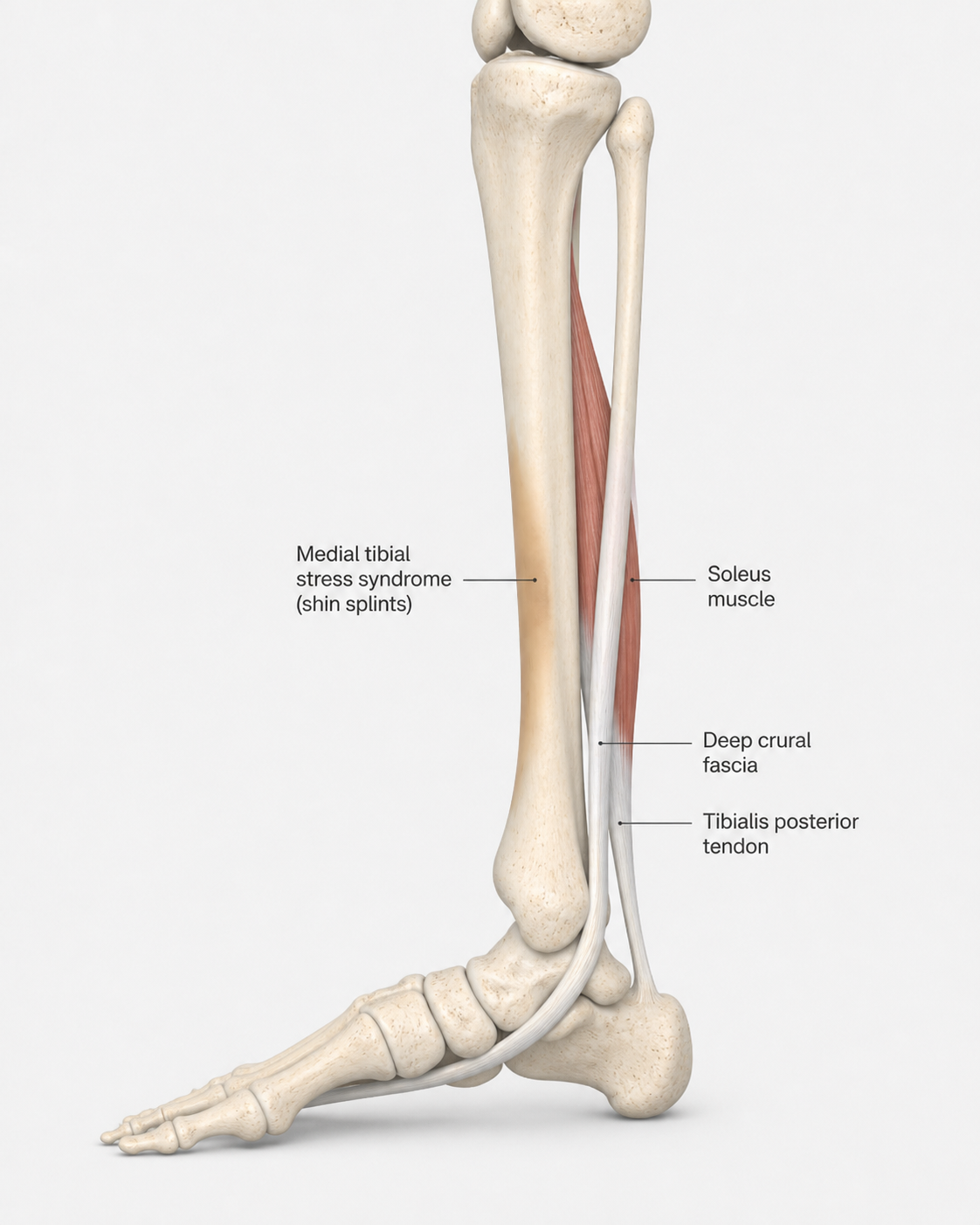
Medial tibial stress syndrome is one of the most common causes of pain along the inside of the shin. You may know this injury as shin splints
Shin splints usually shows up when the inside border of the shin is no longer coping with the amount of load going through it. For runners, this may happen after a change in training volume, speed, hills, surfaces, footwear, strength work, or recovery.
What does shin splint pain feel like?
Medial tibial stress syndrome usually causes pain along the inside border of the shin.
You might notice:
- pain spread along the inside of the shin
- discomfort that comes on with running, jumping, or sport
- symptoms that ease slightly as you warm up, then return afterwards
- tenderness over a broader stretch of the shin rather than one sharp point
- soreness that feels worse later that day or the next morning
Early on, you may still be able to run. The pain may settle once you get moving. But if the shin is repeatedly being asked to handle more load than it can tolerate, symptoms can gradually become more persistent.
How do I know if shin pain is shin splints or bone stress injury?
This is always an important consideration with any shin pain.
Medial tibial stress syndrome and tibial bone stress injuries can feel similar, but they are not managed the same way.
Medial tibial stress syndrome usually feels more spread out along the inside of the shin. It may warm up during activity and feel more manageable early in a run.
Bone stress is more concerning when the pain is more localised, sharper, or less likely to settle once you start moving. Pain that starts affecting walking, keeps worsening, or is sore at rest needs to be taken seriously.
A simple way to think about it:
Shin splints are usually more spread out. Bone stress is often more specific.
That is not a perfect rule, but it is a useful warning sign.
If your symptoms sound more like bone stress, we may recommend an x-ray or MRI.
Why do shin splints happen?
Shin splints usually happen when the load going through the shin is greater than the area can currently tolerate and recover from.
That can be influenced by:
- a recent increase in running volume
- adding speed work, hills, intervals, or harder sessions
- running more often without enough recovery
- changing shoes or surfaces
- reduced calf or lower-leg strength
- foot mechanics that increase load through the inside of the shin
- returning to running too quickly after time off
Can I keep running with shin splints?
Sometimes, rather than stopping running completely, we can just adjust the load. The goal is to find the loading window your shin can currently tolerate.
That means working out what you can still do without making symptoms worse.
For some people, that might mean reducing running volume. For others, it may mean changing frequency, speed, hills, surfaces, or session structure. Some people need a short break from impact. Others can keep running with clear limits.
A useful guide is:
- symptoms should stay mild and manageable
- pain should not worsen as the session continues
- your running mechanics should not change
- symptoms should return to baseline within 24 hours
- pain should not become sharper or more localised
If your shin pain keeps building, changes your running style, or is worse the next day, the current load is probably too much.
How do you treat shin splints?
Treatment starts with understanding what the shin can tolerate now.
From there, the plan usually has three parts:
1. Calm the shin down
This does not always mean complete rest.
It means reducing the load that is irritating the shin while keeping you moving where possible.
That may involve adjusting:
- running volume
- running frequency
- pace
- hills
- speed work
- harder surfaces
- walking load
- jumping or gym impact work
The aim is to bring symptoms under control without unnecessarily removing all activity.
2. Modify load through the foot and lower leg
For some people, the way the foot and lower leg are handling load can increase stress through the inside of the shin.
This is where footwear, taping, and orthotics may help.
Their job is not to “fix” shin splints by themselves.
Their job is to modify load.
If we can reduce the amount of stress going through the irritated area, symptoms may settle more easily and rehab becomes easier to progress.
3. Build the load back up
Once symptoms are settling, we need to improve the leg’s ability to handle running again.
That usually means working on:
- calf strength
- soleus strength
- foot control
- ankle mobility
- lower-leg endurance
- balance and single-leg control
- impact tolerance
- gradual return to running
The goal is a shin that can tolerate the loads you actually want to get back to.
Do orthotics, taping or footwear help shin splints?
Orthotics, taping, and footwear changes are load-management tools. They can change how force moves through the foot, ankle, and lower leg.
That can be useful when the inside of the shin is being overloaded. But they are not the whole plan.
At Functional Soles, we do not use orthotics as a default answer for every case of shin pain. We look at whether they are likely to help your specific presentation.
Sometimes taping is used first to see whether changing load helps. Sometimes footwear changes are enough. Sometimes orthotics are useful for a period while the shin settles and the leg builds capacity again.
How do we help shin pain at Functional Soles?
At Functional Soles Podiatry, we help work out whether your shin pain is likely to be medial tibial stress syndrome, tibial bone stress, or something else that can mimic both.
We look at:
- where your pain is
- how specific or spread out the tenderness is
- how symptoms behave with walking, running, hopping, and loading
- what your recent training has looked like
- how your foot and lower leg are handling load
- whether footwear, taping, or orthotics may help
- whether imaging or referral is needed
- what you can safely keep doing while symptoms settle
Then we build a plan around three clear stages:
Relieve symptoms
Settle the irritated shin and reduce the load that is flaring it.
Restore capacity
Build strength, control, and loading tolerance through the foot, calf, and lower leg.
Reclaim running confidence
Progress your running in a way that gives the shin time to adapt and helps you return with a clearer plan.
What we offer
Our goal is to provide a long-term solution for you and your family.
We believe that every case is different and as such we will always work with you to find the best treatment for you and your needs.