Morton’s Neuroma
Burning, tingling, numbness or sharp pain in the ball of your foot? Learn what Morton’s neuroma feels like, what causes it, and how podiatry treatment can help.
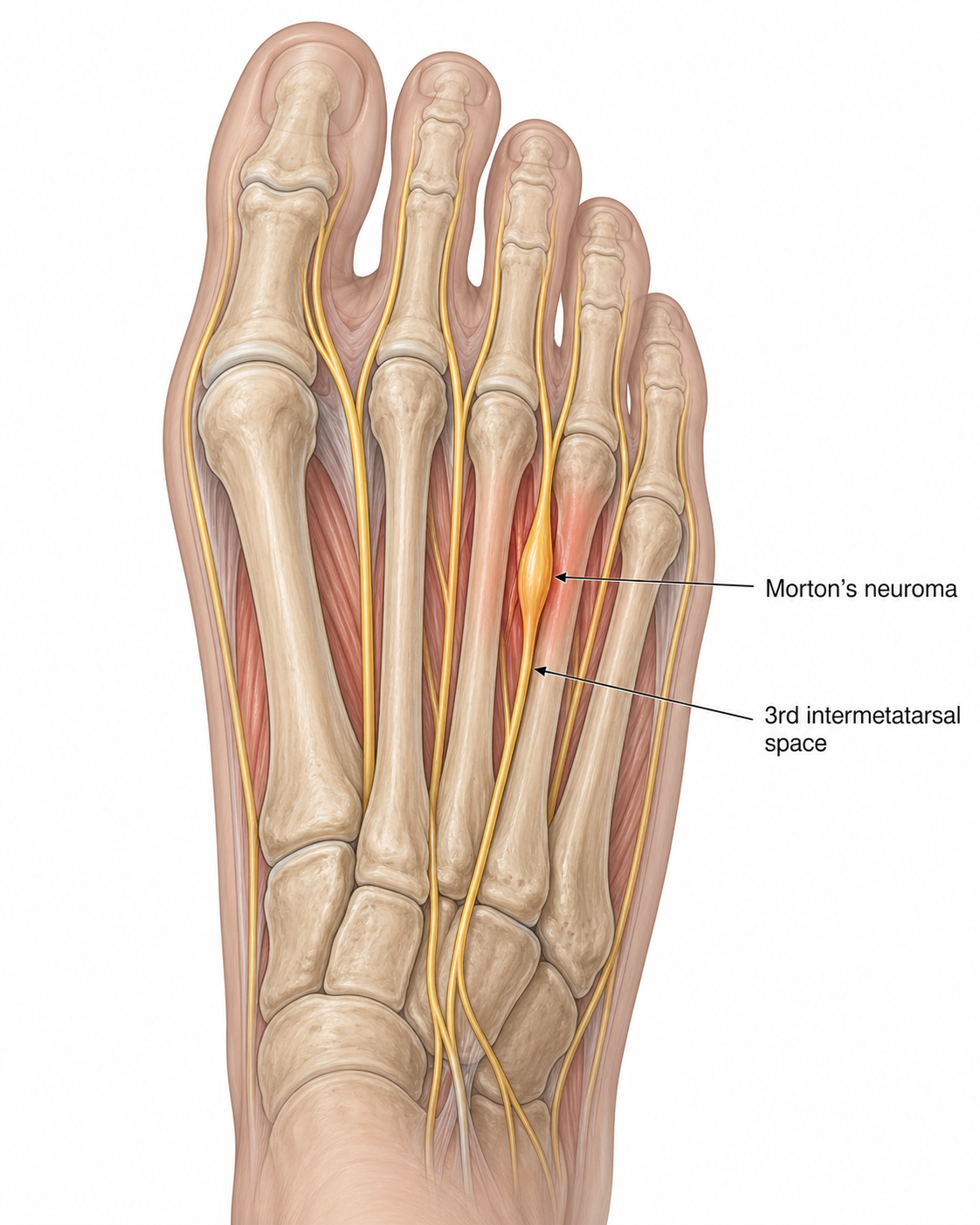
Morton’s neuroma is an irritated, thickened nerve in the ball of the foot, most often between the third and fourth toes.
The nerve sits in a tight space between the metatarsal bones. When that space keeps getting compressed, the nerve can become inflamed, sensitised, and painful during everyday activities such as walking, standing, training, or wearing certain shoes.
What does Morton’s neuroma feel like?
Some people describe burning or tingling in the toes. Others get sharp, electric jolts that make them want to stop mid-step, pull their shoe off, and rub the foot. Some feel a strange bunching or catching sensation in the forefoot, like something is folding underneath them.
That inconsistency is often the clue. A joint problem often feels local and mechanical. A neuroma tends to feel more reactive, sensitive, and unpredictable.
What are the symptoms of Morton’s neuroma?
Common symptoms of Morton’s neuroma can include burning pain, tingling, numbness, sharp pain, electric sensations, or a feeling of walking on a pebble, lump, or fold under the forefoot.
Symptoms are often felt in the ball of the foot and may travel into the toes. Some people feel clear nerve symptoms, while others simply notice that the forefoot feels uncomfortable, squeezed, or difficult to trust.
Morton’s neuroma is usually aggravated by compression. Most people notice symptoms after time on their feet, in tighter shoes, in high heels, or in footwear that squeezes the forefoot. Some people get numbness into the toes. Others find the pain settles when they rest, then returns quickly when they put the same shoes back on.
What causes Morton’s neuroma?
The nerve itself is not the whole story. What matters just as much is the environment around it.
The nerve sits in a tight channel between the metatarsals (the long bones that connect to our toes). When that space is repeatedly compressed, whether by narrow shoes, high heels, forefoot overload, or the way pressure moves through the foot, the nerve can become irritated.
Over time, it may thicken and become more sensitive, until it starts reacting to pressures it used to tolerate without any trouble.
How is Morton’s neuroma diagnosed?
Morton’s neuroma is usually diagnosed by looking at the pattern of symptoms, assessing the forefoot, and working out whether the pain behaves like a nerve problem, a joint problem, or a combination of both.
During an assessment, we look at where the pain sits, whether symptoms travel into the toes, how the foot responds to compression, what shoes aggravate it, and whether nearby joints are also contributing.
Imaging such as ultrasound may be useful in some cases, especially when symptoms are unclear or not improving as expected.
How is Morton’s neuroma treated?
Treatment works best when we focus on changing what is compressing the nerve, rather than only chasing the nerve itself.
In the early stages, the goal is to create more space around the nerve and reduce repeated irritation. This may include footwear changes, forefoot padding, insole modifications or orthotics. This helps to change the load and space around it so every step stops being a provocation.
When symptoms are more stubborn, injection therapy may be considered to settle the irritation.
If conservative treatment is not enough, surgery can become part of the conversation. This may involve decompressing or removing the neuroma.
Do orthotics help Morton’s neuroma?
Orthotics can help Morton’s neuroma when they reduce compression and improve how load moves through the forefoot. Orthotics are used to change the environment around the nerve, reduce repeated irritation, and help the foot tolerate walking, standing, or training with less sensitivity.
For some people, a simple forefoot pad or shoe modification is enough. For others, a custom orthotic may be useful when the load pattern needs to be changed more specifically.
Once symptoms settle, the work is not finished. The next step is rebuilding capacity in the foot so you can return to walking, training, work, and daily life without the nerve flaring again.
The goal is not just short-term relief. It is understanding why the nerve was being compressed in the first place, and making sure that pattern does not repeat itself.
How we help Morton’s neuroma at Functional Soles Podiatry
At Functional Soles Podiatry, we identify why the nerve is being compressed and what needs to change so your foot can tolerate load again.
That may involve footwear advice, forefoot padding, shoe-liner modifications, orthotics, load management, and a clear plan to return to normal activity without the same cycle repeating.
The goal is simple: give the nerve more space, reduce the irritation, and make the forefoot function well again.
What we offer
Our goal is to provide a long-term solution for you and your family.
We believe that every case is different and as such we will always work with you to find the best treatment for you and your needs.